
Our goal is not to promote this sport as a sophisticated thing.
Yuki is the co-founder of the Paddleboard Academy. In 2017, by chance, Yuki, who loves surfing, learned about the existence of paddleboarding as a sport.
While continuously improving her athletic skills and obtaining professional certification from international organizations, Yuki has become a professional paddleboarding coach, hoping to make paddleboarding a lifelong profession for herself. Her AquaX Paddleboard Academy is one of the earliest established paddleboard clubs in Beijing and one of the few clubs with both indoor and outdoor classes.
This sport, which was extremely niche two or three years ago, is now becoming a leisure choice for more young people along with other new urban sports, driven by online communities. It is also the most obvious one that has been softened. This originated from surfing, and the sport that originally had distinct extreme characteristics has become drifting on still water.
Faced with the constant influx of new students, Yuki is changing her teaching approach, as her job is to make it easier for more people to experience the joy of paddleboarding, rather than cultivating a top athlete.
Reporter: How did you first come into contact with paddleboards?
Yuki: It was back in 2017 when I enjoyed surfing, but I couldn’t go to Hainan frequently due to work, so I kept looking for places in Beijing where I could play water sports, such as indoor surfing, cable car water skiing, and wakeboard. Once, I saw a photo posted on my social media account of someone doing yoga exercises on a board in an indoor swimming pool. I found it quite interesting and learned that it was an indoor paddle board.
Reporter: Compared to surfing, which you used to enjoy, does paddleboarding seem a bit dull?
Yuki: The indoor paddleboard I first encountered was actually more like balance training, but I didn’t find it boring either. There are actually many highly competitive events both domestically and internationally, such as crossing the strait for 40 kilometers, kite paddleboarding, which is more extreme, or fancy paddleboarding, which emphasizes skills. Just now in China, more people play in some still water areas, playing relatively calmly, but it can also be very exciting to play.
Reporter: When you first started playing paddleboarding in 2017, what was the general state of this sport in China?
Yuki: There are too few people who know about this sport. I called the people at the club first, but they couldn’t get through. I thought the club had gone bankrupt. At that time, it was already not easy for us to gather 4 or 5 people in the last class.
At that time, I also contacted KEEP to see if it was possible to collaborate with them to promote this sport, but KEEP told us that paddleboarding was too niche and we didn’t have any specific content.
Reporter: When did you decide to turn paddleboarding from an interest into a career direction for yourself?
Yuki.
Reporter: What features did you think had potential and could be popularized in the future?
Yuki: It’s not as exciting or dangerous as surfing. Like some indoor paddleboarding group classes, it can help people who have been injured or have a fear of water to have a physical and psychological transition and adaptation process. After exercising on the water for a period of time, the overall feeling of the body is much better than that of someone who has not practiced before.
Reporter: In the past few years, what interesting gameplay have you tried in your courses?
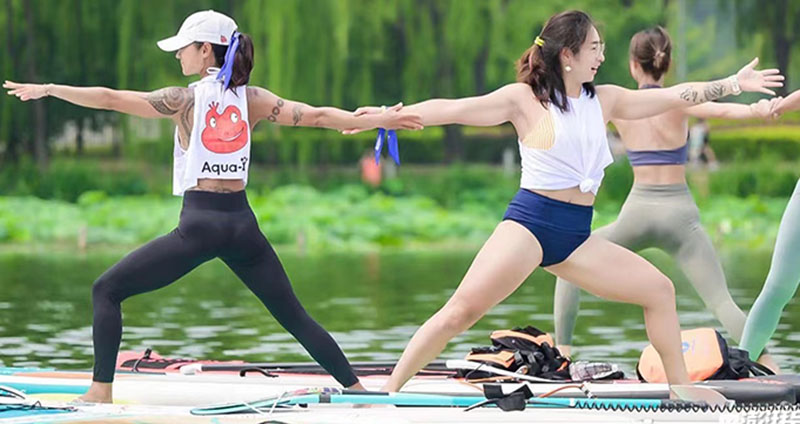
Yuki: Let me talk about indoor classes first. Indoor classes started with paddle yoga. Compared to doing yoga on land, water is not as stable and requires higher levels of balance. There are also some movements of going up and down in the water, which require greater exercise for the heart and lungs. In the paddle yoga class, we also do some more challenging balance projects, such as trying to stand upside down on the paddle. In addition to yoga, we have also added some other content, such as paddle HIIT, paddle CrossFit, and have also offered some African dance classes.
Our outdoor classes actually started in 2019. At that time, a club in Chaoyang Park invited us to their venue to provide them with some group courses. There will be more people in outdoor group classes, usually around 20 people. We will arrange some racing relay races, as well as paddle board skipping rope, including gameplay such as “paddle jumping”.
Reporter: How many members does AquaX Paddle Academy currently have? Have you noticed any significant changes in the number of people since last year?
Yuki: Excluding other platforms, the total number of registered members on our own ride hailing platform is currently around 3800. Last year, the overall number of new members was over 500. In less than half a year this year, the number of registered members has already exceeded 600. Previously, when we had classes on weekends, people might have been dissatisfied, with less than 10 students per class. Now, every class is packed, and even classes with 20 students cannot be scheduled.
Reporter: What differences do you feel between newcomers and enthusiasts in the past circle?
Yuki: More people are still learning this as a social attribute. If you want to learn this thing, you want to master a social language. After class, out of a hundred, there may be 1 or 2 people asking professional related questions, such as how to draw this board in a straight line and how to draw it faster. When someone asks these questions, we will provide answers. But when more people come to play, even if you tell them it’s not right to paddle like this, they won’t listen. They don’t want to delve deeper into it, they just experienced it and took photos after playing the card.
But as a professional organization, we don’t want to promote this sport as a high-precision thing. Often, we also receive feedback from consumers. The most frequently asked question is, can I wear a swimsuit? Do I need sunscreen? Has anyone taken a photo for us?
Reporter: What impact will this change have on your daily teaching?
Yuki: When I first started class, I would be very, very strict with my picking technique. I would ask you to make sure to do it this way, to make sure to do it in this position. But I will gradually realize that if you make such a request, not only will it make them feel that the sport is very boring, but they will also not be able to do it, and it will instead create a strong sense of frustration.
Now in every class, we first teach everyone the necessary safety knowledge, and then let them experience it themselves. If they want to learn some skills and ask me, I will tell them, but I will not actively and forcefully instill them.
Many people come outdoors to play, but their mentality is a bit lackluster. Sometimes they get tired after a few strokes and lie down. In the past, I used to splash them with water and wake them up, but now I don’t really care. I am currently working as a ‘water photographer’, helping everyone take photos. However, when taking photos, I would say that classmates who want to take pictures can chase after me or ask them to make the pose I want. This feels different for them.
Reporter: When did you buy your first set of equipment? Is paddleboarding a sport that requires high equipment?
Yuki: I bought my own equipment in 2018, but after buying it, I threw it away at the club. It’s usually shared among everyone.
There are still some differences in equipment for paddleboards, but ordinary people cannot feel them. Some international racing events also require non inflatable boards that need to be specially air freighted, but for inland cities, it is actually not necessary. To be honest, it is not very interesting to play because it is very shaky, and standing on it feels like standing on a kayak.
The only thing is that some cheap boards are difficult to distinguish their cost-effectiveness, some materials are not used well, and there are safety hazards. After all, they need to be used on water, and once they break, there is a certain danger. I can also buy a board from a OEM factory for a few hundred yuan on Xiaohongshu, but do you dare to buy such things? And the shelf life of this board is very short. You may have spent nearly 1000 yuan to buy one this year, but if you want to take it out and use it again the next year, it will already leak.
Reporter: Which brands have collaborated with you on some joint events?
Yuki: We just had a joint activity with KEEP on paddle yoga. Previously, we mainly collaborated on sports related projects, such as dance studios, which had relatively fewer consumer goods.
The earliest consumer goods brand to do this kind of activity with us was lululemon, and our founder is also a store ambassador for lululemon. Nowadays, there will be more and more, for example, I am also a store ambassador for MAIA ACTION. In addition, our partners include Wodao Yogurt, Benwei Fresh, and Tonillo Lamborghini Energy Drink. We have a tea break during our outdoor classes and will provide products from these sponsors to our students.
Reporter: What else do you personally want to try for paddleboarding?
Yuki: One is something my friend has experienced before. In Thailand, there is a paddleboarding activity that involves drifting along the river for several days and nights. I want to experience this type of Long March activity. Another thing is that I want to try doing handstands on the paddleboard. I haven’t succeeded on land yet, so I want to practice again and give it a try.

Leave a Reply