


Choose the Right Unit by Balancing Power, Portability, and Durability
The biggest mistake when buying an electric propulsion unit is focusing on a single number while ignoring the rest. A product that looks powerful on paper may not be the best fit for real life.
What really matters is how well the unit balances thrust, weight, runtime, waterproofing, and long-term maintenance.
According to IFUNGOO’s latest product data, the propulsion units range from 1.24 kg to 3.3 kg in weight, from 330 W to 2000 W in rated power, and from 8 kg to 35 kg in maximum thrust. The battery lineup spans from 333 Wh to 2304 Wh, with weights from 2.73 kg to 13.8 kg and charging times from 4 to 10 hours.
These numbers already tell you something important: different models are not about “better or worse,” but about which one fits your actual use case.
1. Start with Thrust: Enough Power Matters More Than Big Numbers
The first step is to ensure the thrust matches your total load.
A simple rule of thumb: for every 100 lbs (approx. 45 kg) of fully loaded boat weight, you need about 2 lbs (approx. 0.9 kg) of thrust. If you often face wind, currents, or extra gear, leave some margin.
That is why two motors with similar specs can feel completely different on the water. Insufficient thrust makes the unit work harder, speeds drop, and battery drains faster. With appropriate thrust, the system runs smoother and lasts longer.
IFUNGOO’s lineup is clearly segmented:
| Model | Weight | Rated Power | Max Thrust | Speed at 100 kg load (km/h) |
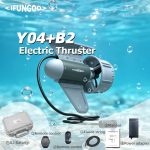
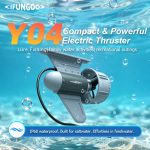
| Y04 | 1.24 kg | 330 W | 8 kg | Gear 1: 1 / Gear 2: 5.6 / Gear 3: 7 / Gear 4: 7.6 |
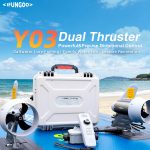
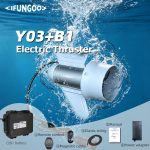
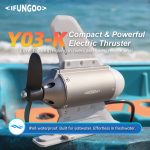
| Y03 | 1.24 kg | 430 W | 10 kg | Gear 1: 2 / Gear 2: 6.2 / Gear 3: 7.6 / Gear 4: 8.4 |
| Y01 | 1.6 kg | 600 W | 13.5 kg | Gear 1: 2 / Gear 2: 7 / Gear 3: 8 / Gear 4: 9–10 |
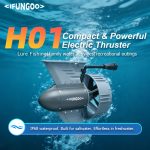
| H01 | 3.3 kg | 2000 W | 35 kg | Gear 1: 5 / Gear 2: 7 / Gear 3: 8–9 / Gear 4: 9–10 / Gear 5: 10–12 / Gear 6: 12–15 |
Leisure cruising → Y03 / Y04
Higher power needs → Y01
Heavy loads → H01 (35 kg thrust + 1000 kg max load capacity)
2. Weight Matters More Than Most Buyers Expect
Many first-time buyers focus on power and overlook total system weight. But once you carry, install, store, and launch the unit yourself, weight becomes a big part of the experience.
IFUNGOO keeps it practical:
Y04 / Y03: 1.24 kg
Y01: 1.6 kg
H01: 3.3 kg
For SUP, kayak, and small leisure boat users, the difference between 1.24 kg and 3.3 kg is not just numbers — it directly affects how often you actually take the unit out.
3. Runtime Depends on Battery Capacity and Efficiency
“How long does it run?” is a fair question. The more accurate answer is: runtime depends on battery capacity, propulsion efficiency, and your actual usage style.
IFUNGOO’s battery data is clear and transparent, covering the full spectrum from portable to long-range:
| Battery Model | Chemistry | Capacity | Nominal Voltage | Weight | Charging Time | Primary Compatibility |
| B2 | LiFePO₄ | 15Ah / 336Wh | 22.4V | 2.73 kg | 4H | Y02 / Y03 / Y04 |
| B3 | LiFePO₄ | 30Ah / 672Wh | 22.4V | 5.5 kg | 7H | Y02 / Y03 / Y04 |
| B1 | NMC | 36Ah / 799.2Wh | 22.2V | 4.7 kg | 8H | Y01 / Y02 / Y03 / Y04 |
| B75 | LiFePO₄ | 75Ah / 1920Wh | 25.6V | 13.8 kg | 10H | Y01 / Y02 / Y03 |
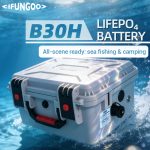
| B30H | LiFePO₄ | 30Ah / 1536Wh | 51.2V | 12 kg | 6.5H | H01 |
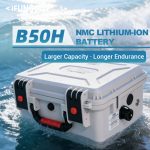
| B50H | NMC | 48Ah / 2304Wh | 48V | 11.5 kg | 8.5H | H01 |
From 333 Wh to 2304 Wh, and from 2.73 kg to 13.8 kg, choosing a battery is not about picking the biggest one — it’s about matching your trip length and carrying willingness.
Portability first → B2 / B3
Balanced choice → B1 offers a good mix of weight and capacity
Long range or heavy duty → B75, B30H, B50H. Among these, B50H provides the highest capacity (2304 Wh) and is purpose-built for the H01.
4. Waterproofing and Durability Should Be Treated as a Baseline
Water sports gear constantly faces spray, rain, salt, and occasional immersion. That’s why waterproofing matters so much.
IFUNGOO propulsion and battery systems are designed to IP68 standards. This means better confidence in rain, spray, and short-term immersion — no need to worry every time the unit gets wet.
Durability goes beyond waterproofing. In saltwater environments, materials, seals, connectors, and build quality are critical. IFUNGOO uses seawater-resistant materials and precision manufacturing for long-term reliability.
5. Easy Maintenance Saves Real Money Over Time
Many products look similar when new. The real difference shows up during maintenance.
IFUNGOO’s modular design is refreshingly practical:
Wear parts like the tail fin and handle can be replaced individually.
That means a small worn part does not force you to replace the whole unit. Repairs are simpler, and long-term ownership cost is lower.
After each use — especially in saltwater — rinse the unit with fresh water, let it dry, and inspect the propeller, tail fin, handle, and connectors for wear or debris. These simple steps extend the life of the system significantly.
6. Battery Choice Should Start with Stability, Not Just Capacity
For electric propulsion, the battery is not an accessory — it is part of the system.
IFUNGOO’s battery lineup is built around IP68 protection and a mix of LiFePO₄ and NMC chemistries. LiFePO₄ versions offer longer cycle life and better thermal stability; NMC versions provide higher energy density and lighter weight.
From a buyer’s perspective, the question is not “Which battery is biggest?” but “Which battery actually matches how I use the product?”
Short, light trips vs. long, frequent outings lead to very different choices.
We recommend looking at the whole system, not just a single spec.
7. Different Use Cases Need Different Priorities
Leisure cruising → Y03 / Y04 (lightweight, smooth)
Commercial / multi-person use → Y01 (stronger output, stable)
Heavy loads → H01 (35 kg thrust + 1000 kg load capacity), paired ideally with B30H or B50H for peak runtime and power
In short:
Don’t ask which model is strongest. Ask which model fits how you actually use it.
8. A Simple Pre-Purchase Checklist
Before buying, ask yourself:
- Does this model suit my real use case?
- Can I carry it comfortably by myself?
- Is the thrust enough for my expected load?
- Is the waterproofing reliable?
- Is maintenance straightforward?
- Does the battery capacity and weight work for me?
If you can answer these six questions clearly, you are much less likely to make the wrong choice.
Closing
An electric propulsion unit should not be chosen simply because it looks powerful or expensive. The best product is the one that balances power, portability, durability, and safety in a way that fits your own use.
That is exactly the logic behind IFUNGOO’s lineup:
Y03 / Y04 for leisure, Y01 for commercial/multi-person use, H01 for heavy loads;
and batteries from B2 to B50H covering 333 Wh to 2304 Wh for different needs — with B30H and B50H purpose-built for the H01.
If what matters most to you is “easy to use and easy to keep using,” don’t just look at one number.
Compare weight, thrust, runtime, and maintenance together — and you’ll make the right choice.
发表回复